Bridging Strategy-Execution Disconnect
Jan 6, 2026
Ella
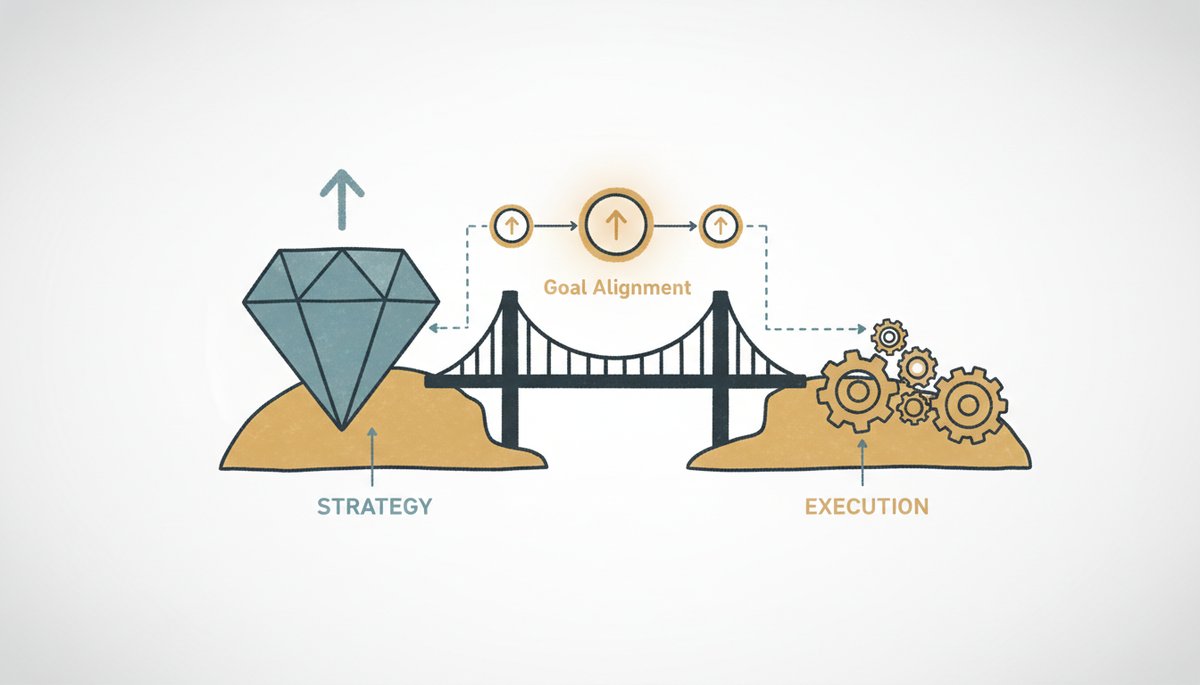
Unlock growth by bridging strategy and execution. Learn how to align your vision with action for measurable results and sustainable success.
Are your product teams moving at lightning speed but struggling to hit the right targets? Many organizations, from agile startups to established enterprises, feel the frustration of a seemingly endless disconnect between grand strategic visions and daily operational realities. This isn't just a minor hiccup; it's a chasm that swallows resources, dampens morale, and ultimately stalls progress toward crucial business goals.
The common pitfall is focusing solely on execution velocity over strategic alignment. Teams are busy, releasing features and completing tasks at a furious pace, but often, that effort doesn't translate into meaningful impact. The "why" behind the work gets lost in the "what," leading to product development that, while technically sound, fails to move the needle on key objectives.
This article will explore why the strategy-execution disconnect plagues so many organizations and how product teams can leverage active goal alignment, comprehensive portfolio visibility, and emerging AI capabilities to ensure every task drives overarching business goals, transforming busy work into strategic triumphs.
The Invisible Wall: Why Strategy Fails to Translate into Execution

The journey from a brilliant strategic blueprint to tangible market success is often fraught with unexpected detours and dead ends. Many organizations find themselves building an invisible wall between their strategic vision and the day-to-day execution, leading to wasted effort and missed opportunities.
The "Why" Gets Lost in the "What"
The initial enthusiasm for a new strategic direction is often palpable. Leaders craft inspiring narratives, set ambitious targets, and share compelling visions of the future. However, as the work is broken down and distributed, this overarching "why" frequently gets diluted or entirely lost. Strategic goals, initially vibrant and urgent, often end up living in static documents—presentations, spreadsheets, or internal wikis—far removed from the dynamic, fast-paced world of daily workflows.
The consequence is dire: teams focus intensely on completing tasks without a clear understanding of their true impact or how they contribute to the larger strategic picture. Developers code, designers design, and product managers plan, but the intrinsic link between their immediate output and the organization's ultimate destination becomes tenuous. This lack of context not only reduces motivation but also leads to decisions made in a vacuum, potentially pulling efforts in conflicting directions.
Velocity Over Value: The Illusion of Progress
In today's fast-paced business environment, there's an understandable emphasis on speed and efficiency. Teams are often celebrated for their velocity—the number of features shipped, tasks completed, or sprints delivered. While these metrics can indicate productivity, they often create an illusion of progress if not tied to strategic outcomes. The critical question shifts from "Are we moving fast?" to "Are we moving fast in the right direction?"
The danger here lies in creating "feature factories." These are teams that are incredibly busy producing outputs but may lack a deep understanding of customer value or strategic direction. They become adept at fulfilling requests rather than solving problems aligned with business goals. This can lead to a bloated product with many features that few users need, significant technical debt, and ultimately, a failure to achieve market differentiation or sustain growth. Without clear goal alignment, this relentless pursuit of velocity can become counterproductive, burning out teams on initiatives that don't genuinely matter.
Beyond Static Documents: Cultivating Active Clarity in Goal Alignment
To bridge the strategy-execution disconnect, organizations must move beyond passive, static representations of their goals. The aim is to cultivate an environment where strategic intent is not just understood but actively lived within daily operations.
From Vague Objectives to Living Goals
In many organizations, goals are defined once, often at the beginning of a fiscal year, and then relegated to dusty documents. They are rarely referenced during day-to-day decision-making, making them difficult to measure and even harder to influence. These vague, often aspirational statements offer little practical guidance for product teams grappling with trade-offs and competing priorities.
The desired state is one where goals are dynamic, easily accessible, and actionable, existing within the same environments where the work itself happens. This means transforming abstract strategic objectives into "living goals" that are continuously visible and provide immediate context for every task. For instance, an OKR (Objective and Key Results) framework can provide this structure, ensuring objectives are ambitious yet measurable, and key results are specific, time-bound, and verifiable. When product management integrates these OKRs directly into their planning tools, teams can see how their epics and user stories directly contribute to larger company objectives.
Integrating Goals into Daily Rituals
To ensure strategic intent permeates all levels, goals must be woven into the fabric of daily team rituals. This isn't about adding more meetings but about re-framing existing ones to center around strategic contributions.
Consider these integrations:
Stand-ups: Beyond "what did you do yesterday, what will you do today, what are your blockers?" add a brief "how does this contribute to our current sprint goal/OKR?" This subtle shift reinforces strategic thinking.
Planning Sessions: When refining backlog items or planning sprints, every item should be evaluated against its contribution to defined business goals. If an item doesn't clearly align, its priority should be questioned.
Reviews and Retrospectives: These are prime opportunities to assess not just what was delivered, but how effectively it contributed to strategic objectives. Did the feature move the needle on the relevant Key Result? What did we learn about our strategy execution?
Visual Management: Utilize digital dashboards or physical whiteboards that prominently display current strategic goals alongside project progress. Make it impossible for teams to forget the ultimate purpose of their work.
Making goal reference a natural part of every decision-making process empowers teams to self-organize more effectively, prioritize with greater conviction, and ensure that every hour spent is an investment in strategic advancement. Tools that allow for real-time goal tracking and progress visualization, like integrated project management platforms, are invaluable here, providing a constant feedback loop.
Unifying the View: Achieving True Portfolio Visibility

One of the most insidious contributors to the strategy-execution disconnect is the fragmentation of information. When work is siloed and leaders lack a holistic view of ongoing initiatives, it becomes impossible to ensure organizational alignment and effective resource allocation.
The Problem of Siloed Work and Fragmented Information
Imagine an organization where product teams use Jira, marketing uses Asana, the sales enablement team relies on Trello, and the executive leadership tracks high-level initiatives in custom spreadsheets or PowerPoint decks. This isn't an uncommon scenario; it's the reality for many. Each department operates within its own digital ecosystem, optimizing for its specific needs, but inadvertently creating barriers to cross-functional understanding.
The consequences are significant:
Lack of a unified view: Product leaders and C-suite executives struggle to get a clear, consolidated picture of all initiatives across the entire portfolio. They can see individual project progress but cannot easily discern how these projects intertwine or contribute to macro-level business objectives.
Delayed discovery of risks and dependencies: Without visibility into parallel projects, teams may unknowingly work on interdependent features without coordination, leading to bottlenecks and rework. Risks that could impact strategic timelines are often identified too late.
Duplicated efforts: Different teams might inadvertently tackle similar problems or develop redundant solutions because they are unaware of what others are doing. This is a direct waste of resources and a significant drag on efficiency.
Difficulty in re-prioritization: When strategic priorities shift, it's incredibly challenging to re-allocate resources effectively if leadership doesn't have a transparent, real-time view of where all resources are currently deployed.
This fragmented landscape hinders effective strategy execution and makes it nearly impossible to ensure that all parts of the organization are pulling in the same direction towards common business goals.
Building a Single Source of Truth for Your Portfolio
The critical need for organizations is to establish a centralized platform or system that acts as a single source of truth for their entire product portfolio. This isn't just about aggregating data; it's about creating a unified, dynamic view that connects individual tasks and projects directly to strategic objectives.
Here's how this plays out:
Centralized Initiative Tracking: All significant product initiatives, from large epics to strategic programs, are tracked in one place. This allows leaders to see the entire landscape of work in progress, planned work, and completed work.
Visualizing Dependencies: A robust portfolio view should clearly highlight dependencies between different projects or teams, enabling proactive risk management and resource scheduling.
Identifying "Strategic Drift": With a holistic view, product leaders can quickly identify if work is veering off course from the intended strategy. If a significant amount of effort is being expended on initiatives not directly linked to current business goals, it signals a need for re-alignment. This allows for early intervention, preventing prolonged efforts on low-impact work.
Ensuring Resource Allocation to High-Value Initiatives: This single source of truth enables a data-driven approach to resource allocation. Leaders can see which teams are working on what, ensuring that talent and budget are channeled towards initiatives with the highest strategic value and potential impact on strategy execution.
Transparency for All Stakeholders: From individual contributors to the C-suite, everyone can understand how their work fits into the broader picture, fostering a greater sense of purpose and organizational alignment.
Platforms that integrate goal setting, project management, and portfolio visibility are essential. They transform raw data into actionable insights, allowing product leaders to make informed decisions that ensure every piece of work contributes directly to strategic success.
The Double-Edged Sword: AI's Impact on Strategy-Execution
The rise of Artificial Intelligence is reshaping industries, and product management is no exception. AI holds immense promise for enhancing strategy execution, but it also introduces new complexities that, if not carefully managed, can exacerbate the disconnect.
How AI Can Worsen the Disconnect (The Noise Problem)
AI's incredible ability to process information, generate content, and automate tasks can be a blessing and a curse. Without proper strategic guidance, AI can actually amplify the strategy-execution disconnect, leading to what we call "the noise problem."
Accelerating Tasks Without Proper Direction: Imagine an AI that can generate user stories, design mockups, or even code snippets at lightning speed. If these AI-generated outputs are not tightly coupled with clear strategic objectives, teams can rapidly produce large quantities of work that miss the mark. They might build features faster, but if those features don't align with business goals, the organization is simply accelerating its movement in the wrong direction.
Risk of Amplifying Busy Work: If an organization struggles with defining strategic priorities, an AI might be trained on existing, non-strategic tasks, making the busy work even more efficient. This doesn't solve the underlying problem; it just makes the organization more adept at unproductive efforts.
Generating "Noise" Rather Than Valuable Output: Without the context of overarching strategy, an AI could produce numerous reports, analyses, or content pieces that, while technically impressive, don't offer actionable insights or contribute to strategic decision-making. It creates a deluge of information that overwhelms teams without truly informing them.
In essence, AI is a powerful amplifier. If your strategic inputs are clear and well-aligned, AI can amplify your success. If your inputs are fragmented or misaligned, AI will amplify your inefficiencies and the existing disconnect.
Leveraging AI to Bridge the Gap (The Opportunity)
Conversely, when strategically applied, AI in product management can be a revolutionary force for bridging the strategy-execution disconnect. It can act as an intelligent co-pilot, constantly linking daily tasks to strategic intent.
AI-Powered Tools for Intelligent Goal Tracking and Progress Prediction: Imagine an AI that monitors all ongoing projects and tasks, automatically linking them to defined OKRs or KPIs. This AI could predict potential deviations from strategic goals, flag risks early, and even suggest re-prioritizations based on real-time data. For example, if a key result isn't progressing as expected, the AI could alert product management and suggest specific tasks or initiatives that could help get it back on track.
Training AI on Full Company Context to Maintain Continuity: As priorities evolve, AI can be trained on the organization's complete strategic context, including historical data, market analysis, customer feedback, and internal goals. This allows AI to act as an institutional memory, ensuring that new initiatives or shifts in strategy are always evaluated against the broader organizational vision, maintaining organizational alignment.
Using AI for Predictive Analytics to Highlight Strategic Deviations or Opportunities: AI can analyze vast amounts of data—market trends, competitor actions, internal project metrics—to proactively identify potential strategic deviations or emerging opportunities. It could suggest, for instance, that a certain product feature, while not initially high priority, now aligns perfectly with a new market trend identified by AI, creating a new avenue for achieving business goals.
AI as an "Intelligent Co-pilot" for Product Managers: AI can assist product managers in various ways:
Automating alignment checks: Automatically scanning project backlogs and highlighting items that lack clear ties to strategic goals.
Synthesizing information: Consolidating insights from multiple sources (customer feedback, market data, internal metrics) and presenting them in the context of strategic objectives.
Recommending optimal paths: Suggesting the most impactful tasks or initiatives to pursue based on current progress towards goal alignment.
Forecasting impact: Providing estimations of how certain features or projects are likely to impact key business metrics and strategic outcomes.
By embedding AI thoughtfully into the product management workflow, organizations can create a system where strategic intent is not just communicated but actively enforced and optimized, transforming how strategy execution is perceived and managed.
Operationalizing Alignment: Practical Steps for Product Teams
Bridging the strategy-execution disconnect isn't a one-time fix; it's an ongoing commitment that requires systemic changes and continuous effort. Product teams are at the forefront of this battle, and there are concrete steps they can take to operationalize alignment and ensure every effort contributes to strategic success.
Define Clear, Measurable Outcomes (OKRs and KPIs)
The foundation of effective strategy execution lies in clearly defined, measurable goals. This means shifting away from vague aspirations and output-focused metrics to concrete, outcome-based objectives.
Shift from Output to Outcome: Instead of tracking "number of features shipped," focus on "increase user engagement by X%" or "reduce churn by Y%." These outcomes directly reflect value creation and impact on business goals.
Set up Objectives and Key Results (OKRs): OKRs are a powerful framework for goal alignment.
Objectives: Should be ambitious, qualitative, and inspirational (e.g., "Delight our customers with an unparalleled onboarding experience").
Key Results: Must be measurable, specific, time-bound, and verifiable (e.g., "Increase new user activation rate from 60% to 80%," "Achieve a Net Promoter Score (NPS) of 50 for new users").
Crucially, these OKRs must be directly linked to the overarching organizational strategy and cascade down to individual product teams. This ensures everyone understands how their work contributes to the bigger picture.
Regularly Review and Adjust KPIs: Key Performance Indicators (KPIs) are vital for monitoring ongoing performance. They should be chosen because they directly reflect progress towards strategic objectives. Product teams should regularly review these KPIs, at least quarterly, to ensure they remain relevant to current strategic priorities. If the strategy shifts, the KPIs should be adjusted accordingly to maintain organizational alignment.
Foster Cross-Functional Collaboration and Communication
Silos are the enemy of strategy execution. Effective alignment requires breaking down departmental barriers and fostering seamless communication across product, engineering, marketing, sales, and leadership.
Break Down Departmental Silos: Encourage regular inter-departmental meetings, joint planning sessions, and shared spaces for information. Create rituals where different teams come together to understand each other's priorities and dependencies. For instance, a "Strategic Sync" meeting involving leaders from all key functions can ensure everyone is on the same page regarding high-level objectives.
Establish Transparent Communication Channels: Utilize collaborative tools that allow for open communication and information sharing. Ensure that strategic objectives, project roadmaps, and progress updates are easily accessible to all relevant stakeholders. This transparency builds trust and helps everyone understand the context behind decisions.
The Role of Product Leaders: Product leaders play a pivotal role in championing organizational alignment. They must act as bridges between executive strategy and team-level execution, translating high-level vision into actionable plans. This involves:
Clearly communicating the "why" behind strategic decisions.
Facilitating discussions that surface and resolve conflicts in priorities.
Advocating for the resources needed to achieve strategic goals.
Celebrating cross-functional successes that demonstrate strong alignment.
Invest in the Right Tools and Technologies
The right technological infrastructure can dramatically facilitate goal alignment and portfolio visibility. This isn't just about buying software; it's about selecting tools that support an integrated, strategy-first approach.
Platforms that Integrate Goal Setting, Project Management, and Portfolio Visibility: Look for solutions that don't just manage tasks but actively link them to strategic objectives. Tools that can visualize product roadmaps, project progress, and their direct connection to OKRs on a single dashboard are invaluable for both teams and leadership. This creates a true single source of truth for your product management efforts.
Exploring AI-Driven Solutions for Strategic Alignment and Execution: As discussed, AI offers immense potential. Investigate platforms that incorporate AI in product management to:
Automate the tracking of goal progress.
Identify potential strategic drifts.
Provide predictive insights into the impact of different initiatives.
Help prioritize work based on its strategic contribution.
When choosing tools, prioritize integration capabilities and ensure they can serve as a central hub for all aspects of strategy execution, from high-level strategic planning down to daily task management.
Conclusion
The strategy-execution disconnect is a solvable problem, not an inevitable organizational reality. By recognizing the pitfalls of focusing solely on velocity and making a conscious shift towards deep strategic alignment, organizations can transform how their product teams operate. It's about ensuring every task, every feature, and every hour invested is purposefully directed towards overarching business success.
By actively integrating goals into daily work, gaining comprehensive portfolio visibility across all initiatives, and intelligently leveraging the power of AI in product management, organizations can move beyond mere busywork. They can create a culture where goal alignment is intrinsic, where organizational alignment is a lived experience, and where strategy execution becomes a powerful, predictable engine for achieving ambitious business goals. It's time to stop running in place and start truly moving your business forward.
Are you ready to stop running in place and start truly moving your business forward? Explore how active goal alignment and AI can revolutionize your product strategy.
Share your thoughts: What are the biggest challenges your organization faces in connecting strategy to execution? Comment below!