Velocity vs. Value in Product
Jan 6, 2026
Ella
Unlock product success! Discover the crucial balance between development velocity and delivering true customer value. Learn how to optimize both for maximum
Beyond Velocity: Why Value Validation Trumps Shipping Speed in Product Strategy
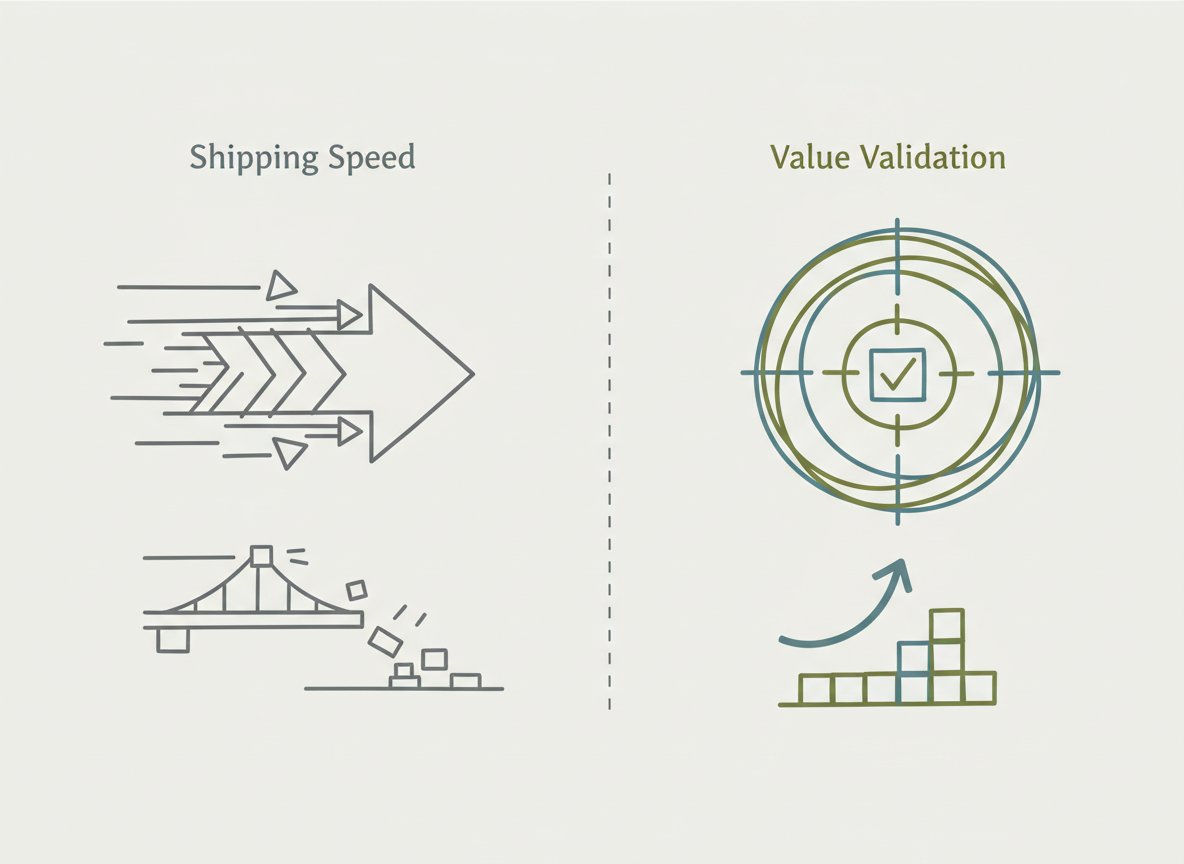
Introduction: The Modern Product Paradox
Are you building products faster than ever, yet still struggling to see meaningful impact? You're not alone. In today's fast-paced digital landscape, product teams are under immense pressure to deliver. Agile methodologies, designed to foster rapid iteration and responsiveness, have inadvertently led to a widespread obsession with "velocity." Teams track story points, measure sprint completion rates, and celebrate every deploy, often equating speed with success.
However, this relentless pursuit of shipping speed can be a dangerous path. While velocity is undoubtedly important for efficient execution, it tells us little about whether we're actually building the right things. Velocity without validated value is like a race car speeding around a track with no finish line, or worse, heading in the wrong direction entirely. The core argument here is simple yet profound: focusing on delivering genuine value, validated through rigorous discovery and user feedback, should always take precedence over merely increasing shipping speed.
In this comprehensive guide, we'll explore the pitfalls of the "build trap," unpack the untapped power of robust product discovery, and outline how strategic product management can help you prioritize for true impact. You'll learn how to shift your team's focus from mere output to impactful outcomes, ultimately building products that users love and businesses thrive on.
The "Build Trap": When Speed Becomes a Snare
Understanding the Velocity Obsession:
The agile movement brought with it a laudable goal: to build software in a more iterative, responsive, and customer-centric way. Metrics like story points, sprint velocity, and burn-down charts were introduced to help teams understand their capacity and plan work. However, over time, these tools often morphed from internal planning aids into external performance indicators. The pressure to "ship fast," "iterate quickly," and show continuous progress has led many organizations to prioritize the visible output of features over the deeper, less tangible work of understanding user problems and validating solutions.
This emphasis on speed creates a potent cocktail of incentives. Product managers might feel compelled to keep the development team busy, pushing features into sprints even if their value hasn't been thoroughly explored. Engineers, driven by the desire to deliver, focus on implementation efficiency. While this can lead to impressive short-term velocity numbers, it risks creating a "feature factory" where the output is high, but the actual impact remains elusive. Traditional velocity metrics, without the crucial context of what is being built and why, can be incredibly misleading.
The Cost of Building the Wrong Things, Faster:
The "build trap" is the state where organizations become incredibly efficient at cranking out features that provide little to no real value to their users or the business. This isn't just a theoretical problem; it has very real, tangible costs:
Resource Drain: Every feature built, regardless of its utility, consumes precious engineering time, design efforts, QA resources, and even marketing spend. These are finite resources that, once spent, cannot be recovered. Imagine dedicating weeks or months of a skilled team's effort to a feature that never sees significant adoption.
Opportunity Cost: Perhaps even more insidious than direct resource drain is the opportunity cost. Every hour spent building the wrong thing is an hour not spent building something that could have made a real difference. What truly valuable features or solutions were neglected because the team was busy in the build trap?
Customer Disillusionment and Churn: When users are constantly presented with irrelevant features, confusing interfaces, or solutions that don't address their core user problems, they become disillusioned. This can lead to decreased engagement, negative reviews, and ultimately, customer churn. The promise of "agile" and "rapid iteration" rings hollow when the output isn't valuable.
The Illusion of Progress vs. Actual Value Creation: High velocity provides an illusion of progress. Stakeholders see continuous releases, and teams feel productive. However, if these releases aren't moving key outcome metrics – like user retention, activation, or revenue – then the progress is superficial. True value creation comes from solving real problems for real people, not just from shipping code.
Recognizing You're in the Trap:
How do you know if your team or organization has fallen into the build trap? Look for these tell-tale signs:
High feature usage but low customer satisfaction: You're shipping many features, and perhaps some are even being used, but your Net Promoter Score (NPS) or customer feedback remains stagnant or declines.
An endless backlog: Your product backlog grows faster than you can ever hope to address it, often filled with requests that haven't been deeply analyzed or validated.
Stagnant growth or key metrics: Despite continuous feature releases, your core business metrics – such as conversion rates, user retention, or average revenue per user (ARPU) – aren't improving meaningfully.
The "we shipped it, now what?" syndrome: Features are deployed, perhaps announced, and then quickly forgotten, with little follow-up on their actual impact or success.
Team fatigue and burnout: Constantly pushing for speed without a clear sense of purpose or impact can lead to a demoralized team.
Solutions looking for problems: Your team spends more time brainstorming cool new features than understanding the underlying user problems those features might address.
If any of these scenarios sound familiar, it's a strong indicator that your product strategy might be overly focused on velocity at the expense of validated value.
The Untapped Power of Product Discovery
Why Discovery is Hard (and Often Rushed):
If the solution to the build trap is to focus on value validation, why isn't every team doing it effectively? The truth is, product discovery is hard work, and it's often the first thing to be cut when deadlines loom or pressure mounts.
The inherent uncertainty of user problems and market needs: Discovery deals with ambiguity. You're exploring the unknown, trying to understand complex human behaviors and unpredictable market dynamics. This contrasts sharply with the more predictable nature of execution (once a solution is defined).
Pressure from stakeholders to move straight to execution: In many organizations, there's a strong bias towards action. Stakeholders often want to see tangible progress (i.e., built features) and might resist efforts that don't immediately translate into code. "Why aren't we building yet?" is a common refrain.
Lack of dedicated time and resources for thorough investigation: Effective discovery requires dedicated time, skilled practitioners, and often, budget for research tools or user incentives. If product managers are solely focused on backlog grooming and sprint planning, there's little room for deep exploratory work.
Misconceptions: Common myths include "Discovery is just for new products" (false, it's continuous for existing products too), or "we know what users want" (a dangerous assumption that often leads to the build trap).
Core Principles of Effective Value Validation:
To harness the power of product discovery, teams must embrace a few core principles:
Focus on user problems, not just feature requests: Customers often articulate solutions ("I need a button that does X") rather than the underlying problem ("I need to achieve Y, and currently it's difficult because Z"). Effective discovery digs deeper to uncover the true pain points.
Hypothesis-driven development: Treat every idea as a hypothesis. Instead of assuming a feature will deliver value, frame it as: "We believe [this solution] will achieve [this outcome] for [this user segment]." This shifts the focus from building to learning.
Emphasizing learning over immediate building: The goal of discovery isn't to create a perfect specification; it's to gather enough evidence to de-risk a solution before significant investment in building. Sometimes, the most valuable learning is that an idea isn't worth pursuing.
Qualitative and quantitative research techniques: A balanced approach is key. Qualitative methods (interviews, usability tests) provide depth and understanding of why users behave a certain way, while quantitative methods (surveys, analytics) provide breadth and validate patterns.
Key Discovery Activities for Product Teams:
Integrating product discovery into your product strategy means embedding specific activities into your regular workflow. This isn't a one-off phase but a continuous process.
User interviews and empathy mapping: Directly engaging with target users to understand their goals, frustrations, needs, and behaviors. Empathy mapping helps consolidate these insights into a shared understanding of the user.
Problem framing and solution ideation: Clearly articulating the user problem to be solved and then brainstorming a wide range of potential solutions before narrowing down to the most promising ones.
Prototyping and user testing: Creating low-fidelity (sketches, wireframes) to high-fidelity (interactive mockups) prototypes to test assumptions about a solution's usability and desirability before writing a single line of code. This is critical for value validation.
Experimentation frameworks: Utilizing methods like A/B testing, multivariate testing, or lean experiments to test hypotheses with real users in a controlled environment, gathering data on actual behavior.
Strategic Product Management: Prioritizing for Impact
Beyond Simple Feature Prioritization:
Many teams prioritize features based on "who shouts loudest," the HIPPO (Highest Paid Person's Opinion), or simply a first-in, first-out mentality. This reactive approach inevitably leads to the build trap. Strategic product management demands a more thoughtful, value-driven approach to feature prioritization.
Instead of just listing features, product leaders should leverage frameworks that tie potential features directly to expected value and effort. Frameworks like RICE (Reach, Impact, Confidence, Effort), MoSCoW (Must have, Should have, Could have, Won't have), or Opportunity Scoring (based on user satisfaction and importance) help teams objectively evaluate and compare initiatives. The key is to move beyond simple lists and ask: "Which features, if built, would deliver the most validated value for our users and business, relative to the effort required?"
The Role of Product Strategy in Value Creation:
At its heart, product strategy is about defining where to play and how to win. It's the blueprint that guides all product decisions, ensuring they align with overarching business objectives and customer needs.
Defining clear desired outcomes instead of just outputs: A robust product strategy articulates what success looks like in terms of measurable outcomes (e.g., "increase user retention by X%," "reduce customer support tickets for Y issue by Z%") rather than just a list of features to ship.
Communicating "the why" to the development team: An effective strategy empowers the entire team by clearly articulating the purpose behind the work. When engineers understand the user problems they are solving and the value they are creating, they are more engaged and can make better decisions independently.
Creating a cohesive product roadmap driven by validated insights: A strategic roadmap isn't just a Gantt chart of features. It's a narrative that shows how validated insights from product discovery will lead to specific outcomes over time. It groups initiatives by themes related to user problems or business goals, not just a chronological list of tasks.
Image Suggestion: A visual representation of a product roadmap with value-driven themes instead of just a list of features.